💰 Exclusive Price Leak Details
Significant price leak reveals Vivo X300 series will see substantial price increases in India compared to previous generation. Both models positioned as premium flagships against OnePlus 15 and Oppo Find X9 series.
Vivo X300
Vivo X300 Pro
Single premium variant
Accessories
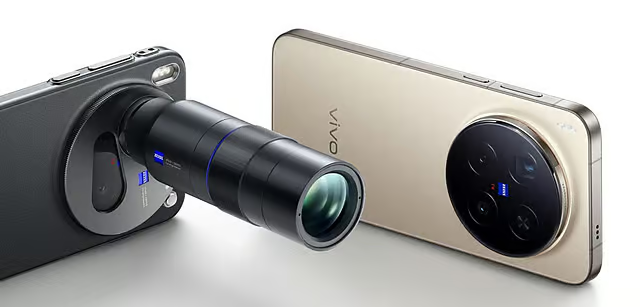
Zeiss 2.35x teleconverter
📝 Leak Source Information
According to tipster Abhishek Yadav, who shared exclusive pricing details on social media platform X. The leaked prices show significant increases compared to previous X200 series, with base model seeing ₹10,000 hike and Pro model jumping ₹15,000.
Massive Price Leak Reveals Vivo's Premium Strategy
In a major development ahead of the December 2 India launch, complete pricing details for Vivo's flagship X300 series have surfaced online. The leak reveals Vivo's aggressive premium positioning with significant price increases across both models, potentially making them more expensive than key competitors like OnePlus 15 and Oppo Find X9 series.
The X300 series represents Vivo's most advanced camera technology to date, featuring Zeiss-tuned optics and powerful MediaTek Dimensity 9500 chipsets. With the telephoto extender kit also priced at a premium ₹19,999, Vivo is clearly targeting photography enthusiasts and professionals willing to invest in top-tier mobile imaging capabilities.
Key Specifications & Features
Vivo X300 Specifications
| Display | 6.31-inch BOE Q10+ LTPO OLED, 1.5K resolution, 120Hz |
| Processor | MediaTek Dimensity 9500 (3nm) with Mali-G1 Ultra MC12 |
| RAM/Storage | Up to 16GB LPDDR5X RAM, 1TB UFS 4.0 storage |
| Main Camera | 200MP main + 50MP ultrawide + 50MP periscope telephoto |
| Front Camera | 50MP selfie camera |
| Battery | 6,040mAh with 90W wired and 40W wireless charging |
| Durability | IP68 & IP69 water and dust resistance |
Vivo X300 Pro Specifications
| Display | 6.78-inch BOE Q10+ LTPO OLED, 1.5K resolution, 120Hz |
| Processor | MediaTek Dimensity 9500 (3nm) with dual imaging chips |
| RAM/Storage | 16GB LPDDR5X RAM, 512GB UFS 4.0 storage |
| Main Camera | 50MP Sony LYT-828 main + 50MP ultrawide + 200MP periscope telephoto |
| Front Camera | 50MP selfie camera |
| Battery | 6,510mAh with 90W wired and 40W wireless charging |
| Durability | IP68 & IP69 water and dust resistance |
Camera Innovation & Telephoto Extender
The Vivo X300 series brings revolutionary camera capabilities with its unique sensor arrangement. Interestingly, the standard X300 features a 200MP main sensor while the Pro model uses a 50MP Sony LYT-828 primary sensor but pairs it with a massive 200MP periscope telephoto lens.
Both devices feature Zeiss-tuned optics and benefit from Vivo's advanced imaging chips. The V3+ chip handles computational photography while the VS1 chip provides pre-processing capabilities, resulting in superior image quality, especially in low-light conditions.
The telephoto extender kit, priced at ₹19,999, includes Zeiss 2.35x teleconverter lenses that provide extended optical zoom without quality loss. The kit features NFC support for automatic activation when attached.
Market Positioning & Competition
With these leaked prices, Vivo positions the X300 series firmly in the ultra-premium segment. The X300 starts at ₹75,999 while the X300 Pro reaches ₹1,09,999, making them more expensive than their direct competitors.
The significant price increase compared to previous generation reflects Vivo's confidence in its camera technology and premium positioning. However, this pricing strategy may face challenges in the competitive Indian smartphone market, where consumers are increasingly value-conscious.
Official Launch Details
Vivo has confirmed the India launch for December 2, 2025, at 12 PM IST. The company has teased an India-exclusive Summit Red color variant for the standard X300 model, while the Pro version will be available in Dune Brown and Phantom Black finishes.
While the leaked prices appear substantial, official pricing will only be confirmed during the launch event. The devices will run Android 16-based OriginOS 6 out of the box, marking Vivo's transition from FunTouch OS in the Indian market.